Semax: what it is, what it is used for, and what the studies actually cover

The short answer
Semax is a synthetic seven-amino-acid peptide built from a fragment of the hormone ACTH and developed in Russia, where it is used as a nasal drug for stroke and other brain conditions. Elsewhere it is used as a nootropic for focus, often alongside Selank. Its evidence is mostly animal studies plus a few small, largely Russian human studies.
Semax has had an unusual career. It began as a Russian drug for stroke and brain injury and turned into a staple of nootropic forums, where it is sold as a brain-booster that raises BDNF and sharpens focus, usually with the evidence level left out. Along the way it picked up a family of modified versions, N-acetyl Semax amidate and Adamax, that users argue about as “better” Semax. This page puts the evidence back. It explains what Semax is, what it is used for, what the studies actually cover, what is known about the variants (very little), what is known about safety, and what users report, with a primary source for every claim. It is educational only, and nothing here is medical advice. For the wider context, start with our explainer on what peptides are, and for the most-searched recovery peptide see the companion BPC-157 overview.
What is Semax?
Semax is a synthetic heptapeptide, a chain of seven amino acids with the sequence Met-Glu-His-Phe-Pro-Gly-Pro. An independent review by the Alzheimer’s Drug Discovery Foundation describes it as “a heptapeptide (Met-Glu-His-Phe-Pro-Gly-Pro) which is a derivative of the adrenocorticotrophic hormone (ACTH) that possesses ACTH’s neurotrophic effects and lacks its hormonal activity” (Cognitive Vitality / ADDF). In structural terms it joins the ACTH(4-7) fragment of that hormone to a C-terminal Pro-Gly-Pro (PGP) tripeptide, an addition its developers describe as augmenting the peptide’s stability (Dmitrieva et al., 2010). The ADDF review notes that the ACTH fragments have a short half-life and that the Pro-Gly-Pro modification, made in the 1970s, extended their effects to 20 to 24 hours in animal models (Cognitive Vitality / ADDF). The “ACTH but not the hormone” framing captures the whole design goal: chemists kept the part of ACTH thought to act on the brain and engineered out the part that drives cortisol and stress hormones.
The compound is not a Western invention. Semax was developed at the Russian Academy of Sciences, and, as the same review notes, “there are few published English-language studies in humans” (Cognitive Vitality / ADDF). It is usually taken intranasally, by dropper, rather than by injection. None of this, on its own, tells you whether it works or whether it is safe outside Russian clinical practice. Those are separate questions, and the rest of this page takes them one at a time.
What is Semax used for?
Semax is used for two quite different things: in Russia it is a neuroprotective drug for stroke and other brain conditions, and elsewhere it is used as a nootropic for focus, attention and learning in healthy people. According to the ADDF review, Russian clinical use covers stroke, dyscirculatory encephalopathy (a chronic cerebrovascular condition), Parkinson’s disease, ocular nerve atrophy, and newborns with neurological deficits (Cognitive Vitality / ADDF). The nootropic use is mostly a community phenomenon, described further down this page. The “benefits” people search for map onto those uses, but the evidence behind each one is very different, so the table below puts a plain-words evidence level next to each.
| Use | Who uses it this way | What has been studied | Evidence level, in words |
|---|---|---|---|
| Stroke recovery | Russian clinical practice | Two studies in stroke patients: one reported better neurological function when added to standard care; one in 110 patients reported higher blood BDNF. Both available only as abstracts, articles in Russian | Small human studies, not independently replicated |
| Focus, attention, memory (healthy) | Nootropic users worldwide | Two pilot studies: one in 24 people measured a change in a resting brain-imaging signal; one Russian report described better attention and short-term memory | Small pilot studies; no trial of real-world performance |
| Other neurological conditions | Russian clinical practice | In rat models of Parkinson’s disease, results were mixed: some behaviors improved, others did not, and one study found no change in motor activity | Mostly animal studies; human data largely not in English |
| Memory in dementia or cognitive aging | Marketed for “brain aging” | The ADDF tally of clinical research for this use: “None” | No clinical evidence |
Sources for the table: Cognitive Vitality / ADDF for every row; the Parkinson’s row also draws on Slominsky et al., 2017, which found that Semax did not change motor activity in rats with induced parkinsonism.
Read every row as “being investigated,” not “established.” A marketing line such as “boosts BDNF and sharpens your mind” and a scientific line such as “changed a measurement in a rat, or a score in a small study” are not the same claim. The network’s deeper, evidence-first pages examine each area in detail:
- Cognition and focus: what the Semax cognitive-function research actually shows, and the wider question of whether nootropic peptides actually improve focus.
- The nasal route specifically: Semax nasal spray versus injection.
- Compared with its Russian sibling peptide: Selank versus Semax, and the shared Semax and Selank nootropic overview.
How is Semax thought to work?
Semax is thought to act mainly by raising the brain’s own neurotrophic signaling, especially brain-derived neurotrophic factor (BDNF), but the detailed picture comes almost entirely from animal and cell studies rather than from people. In one rat study, a single dose of Semax (50 micrograms per kilogram) produced roughly a 1.4-fold rise in BDNF protein, a 1.6-fold rise in activation (tyrosine phosphorylation) of its receptor trkB, and larger increases in the messenger RNA for both, in the hippocampus (Dolotov et al., 2006). BDNF and trkB are central to how neurons survive, form connections, and support learning, so an agent that nudges that system upward is biologically interesting.
A second line of work looks at what happens after a brain injury. In rats subjected to cerebral ischemia, Semax and its PGP fragment were reported to activate the transcription of several neurotrophins (BDNF, NT-3, and NGF) and their receptors, with the authors concluding that Semax promoted the “earlier upregulation” of BDNF and two of the receptor genes compared with injury alone (Dmitrieva et al., 2010). Related rodent work found that Semax also shifts monoamine systems, raising brain serotonin activity while leaving dopamine largely unchanged on its own, yet amplifying the dopamine response when a stimulant was given (Eremin et al., 2005). The honest summary is that these are plausible, mostly preclinical mechanisms observed in rats, not confirmed pathways of action in humans, and the researchers who study it say as much: even after decades of use, “the molecular mechanisms of Semax’s action are still not completely understood” (Dmitrieva et al., 2010). A compound can move a measurable signal in a rat brain while nobody yet knows exactly how it produces a clinical effect in a person, and that is precisely where Semax sits.
What does the evidence actually show?
Almost all of the evidence for Semax comes from animals and from a small number of mostly Russian-language human studies, not from large, independent, Western-standard trials. The independent ADDF appraisal is blunt about the imbalance: Semax “is used in Russia as a neuroprotective drug for stroke; however, there is little evidence whether it would improve cognition in healthy patients and no evidence for Alzheimer’s disease,” and even for its established use “published literature of well-conducted studies is lacking” (Cognitive Vitality / ADDF). The same review counts the human record as two small pilot studies in healthy individuals and two studies in stroke patients, alongside several preclinical animal studies.
The specifics matter. The one healthy-volunteer study it describes in detail enrolled just 24 subjects and measured a change in a resting brain-imaging signal, not an improvement in real-world performance, and several of the supportive human reports are available only as abstracts or in Russian (Cognitive Vitality / ADDF). A later Russian imaging study in 52 healthy participants, published as a short report, compared Semax, Selank and placebo and again measured resting brain connectivity rather than performance (Panikratova et al., 2020). For memory in dementia or age-related decline, the ADDF tally of clinical research is a single word: “None.” That does not mean Semax has been proven not to work; it means the large, controlled, independently replicated trials that would show whether it helps a healthy person think better have not been done. Researchers at Sciensano, Belgium’s public health institute, who identified Semax and Selank in seized preparations, put it plainly: to its knowledge, these peptides “have not completed any clinical trials” (Vanhee et al., 2020).
Which forms of Semax have been studied?
Almost everything known about Semax in people comes from the plain peptide given into the nose; injection has been used mainly in animal studies and one small imaging study, and the modified variants sold online have essentially no published biology. Online, Semax is offered both as freeze-dried powder intended for injection and as nasal sprays, according to a survey of products sold online (Vanhee et al., 2020). The table sets out what was actually studied for each form.
| Form | What it is | What has been studied | Evidence level, in words |
|---|---|---|---|
| Nasal Semax (drops or spray) | The original peptide in solution, the form used in Russian practice | The 24-person healthy-volunteer imaging pilot used an intranasal solution, and the rat BDNF study cited on this page used the nasal route (ADDF; Dolotov et al., 2006) | Small human pilots plus animal studies |
| Injectable Semax | The same peptide, given by injection | Rodent studies have used injection into the abdominal cavity, and one rat study reported that nasal and injected Semax both improved a passive-avoidance learning test (ADDF); the mouse monoamine study above also used injection (Eremin et al., 2005); the 52-person imaging report describes an injection (Panikratova et al., 2020) | Animal studies plus one small human imaging study |
| N-acetyl Semax (Ac-Semax) | Semax with an acetyl group added to its starting end | One 2016 lab chemistry and cell-culture study of how it binds copper and zinc (Magrì et al., 2016); a 2013 Russian note on its stability, available as a title only (Shevchenko et al., 2013) | Lab chemistry and cell studies only; no animal or human data found |
| N-acetyl Semax amidate (NA-Semax-NH2) | Acetylated at one end and amidated at the other | Listed as a compound in PubChem, with no linked research papers (PubChem) | Nothing found in published research |
| Adamax | A seller-named Semax derivative | No PubChem record and no PubMed papers found (PubMed search) | Nothing found in published research |
There are no head-to-head human trials of nasal versus injected Semax for cognition. Our sister site walks through the practical trade-offs in Semax nasal spray versus injection.
What is N-acetyl Semax amidate?
N-acetyl Semax amidate is Semax with two chemical caps added: an acetyl group on the starting (N-terminal) end and an amide on the finishing (C-terminal) end. PubChem records it as Ac-Met-Glu-His-Phe-Pro-Gly-Pro-NH2, the same seven amino acids as Semax with those two end modifications, also listed under the shorter name “N-acetyl semax” (PubChem). Online, those caps are the selling point: the variant is pitched as a longer-lasting or stronger Semax. As the rest of this section shows, that has not been tested.
The problem is that this pitch runs well ahead of the research. PubChem links no research papers to the amidated compound (PubChem), and the closest published work concerns a related but different molecule, Semax with only the acetyl cap. A Russian group published a short 2013 note on the stability of “Semax acetyl” against enzyme breakdown in biological media; its record carries no abstract, so its findings cannot be reported here (Shevchenko et al., 2013). A team in Catania, Italy, compared acetylated and plain Semax in a 2016 lab study and found that acetylation changed how the peptide binds copper. More interesting for the “upgrade” story, plain Semax protected neuroblastoma cells from copper toxicity while the acetylated form did not, which the authors took as showing “the crucial role played by the free NH2 terminus in the cell protection” (Magrì et al., 2016). That is one narrow cell-culture result and does not show the variant is worse in people. It does show that “modified” does not automatically mean “better.”
Put plainly: no published animal or human study of N-acetyl Semax amidate turned up in PubMed or PubChem as of October 2026. Claims that it is stronger, longer-acting, or better at reaching the brain are untested extrapolations.
Adamax vs Semax: what is the difference?
The difference is that Semax has decades of published research, mostly Russian and mostly preclinical, while Adamax has none that we could find. Adamax is a name used by online sellers for a modified Semax. Searching PubMed for “Adamax semax” on October 12, 2026 returned no results (PubMed search); a search for “Adamax” alone returned papers on unrelated topics, mostly a machine-learning method of the same name, and none about Semax. PubChem has no compound record under that name either. Because no peer-reviewed source defines Adamax’s structure, we cannot independently confirm what modification a given product contains, let alone what it does.
So a fair comparison is short. Semax: a defined peptide with Russian clinical use, small human studies, and a body of animal work. Adamax: a seller-named variant with no published chemistry, animal, or human data. Anyone choosing between them is choosing between thin evidence and no evidence, and any “Adamax is stronger” claim rests on reasoning about chemistry, not on a study.
What are the reported side effects and safety unknowns?
Semax’s safety profile outside Russian clinical use is largely uncharacterized, because rigorous human safety data are thin. The ADDF review states plainly that “little human evidence exists for potential side effects.” Drawing on a published review, it reports that the most common adverse events described are discoloration of the nasal cavity in about 10 percent of patients and an increase in blood glucose in diabetic patients in about 7.4 percent, and it adds the crucial caveat that “long-term side effects are unknown” and that drug interactions are “not known” (Cognitive Vitality / ADDF). A record that looks benign in routine use is reassuring as far as it goes, but “few reported problems in Russian practice” is not the systematic toxicology, interaction, and long-term safety data that an approved medicine must carry. None of that limited safety record applies to the N-acetyl amidate or Adamax variants, which have no published safety data at all.
Layered on top of those biological unknowns is a product-quality problem tied to how Semax is actually sold outside Russia. The “research use only” vials shipped by online vendors carry none of the guarantees a pharmacy product does. A peer-reviewed forensic analysis of the ten most frequently encountered falsified peptide drugs on the Belgian market (not Semax specifically), bought from suspected illegal internet pharmacies, found “a low purity (ranging between 5% and 75% for cysteine containing peptides),” wide variation in the actual amount of drug per unit, lead in one sample, and arsenic in multiple samples at concentrations “up to ten times the ICH toxicity limit for parenteral drugs” (Janvier et al., 2018). So the safety picture carries two layers of uncertainty at once: what Semax does in a human body over the long term, which is genuinely under-studied, and whether the vial in hand even contains what the label claims.
Who should be cautious with Semax?
The honest answer is that nobody has mapped this properly, so the cautions come from a thin record. The ADDF review reports an increase in blood glucose in about 7.4 percent of diabetic patients in Russian use, which makes people with diabetes the clearest group to be careful, and it says drug interactions are “not known” and long-term side effects are unknown (Cognitive Vitality / ADDF). That means anyone taking other prescription medicines has no interaction data to lean on. It is also worth remembering that “few problems reported” in a small literature is not the same as a safety profile.
Is Semax taken with Selank?
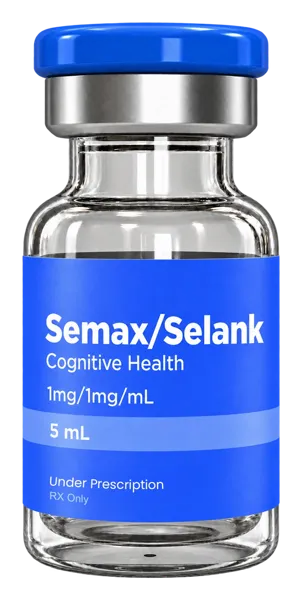
Yes, pairing Semax with Selank comes up often in the community posts our tracker collected, and some sellers offer the two together. The research does not test them as a pair: the 52-person Russian imaging study gave Semax, Selank, or placebo to separate groups (Panikratova et al., 2020), and a rat study of induced parkinsonism found that Selank lowered anxiety while neither peptide changed motor activity (Slominsky et al., 2017). For Selank on its own, see our Selank overview; for a side-by-side, see Selank vs Semax.
What are people saying about Semax?
Skepticism was the most common tone in the 13 posts on X that our community tracker collected between July 17 and 19, 2026. The main threads were:
- Focus and skill-building. Users describe Semax as something they take for focus, pattern recognition and learning, usually as one item in a wider nootropic stack rather than on its own.
- Stacked with Selank. Pairing Semax with Selank is common, sometimes as a combined preparation, with users comparing variants and formulations.
- Variants and formulations. Some commenters discuss preferences among Semax variants and formulations. As the variant sections above show, no published comparison backs one over another.
- Nasal routines and cycling. Posters describe using it as a nasal spray for a set period and then taking a break, and debate which liquid to prepare it in. Some say it does not irritate their nose. These are personal routines, not tested protocols.
- Access, not efficacy. In posts ahead of the July 2026 FDA advisory meeting, several users stressed that it was about access through compounding, not proof that Semax works.
These posts are a small, three-day snapshot from one platform. They show how people use Semax, not whether it improves cognition in healthy adults, which is the question the evidence has not answered.
How to think about Semax
If you are weighing Semax, the most useful move is to hold two separate facts at once instead of letting the marketing blur them: the molecule and the marketing. The molecule is real and genuinely interesting, a stable, well-defined ACTH-derived heptapeptide with repeatedly reported effects on the BDNF system in rats and a long track record of clinical use in one country. The marketing is mostly a hopeful extrapolation from that record, and the variants stretch it further, borrowing Semax’s research to sell molecules that have little or none of their own.
If your actual goal is sharper focus, better cognitive resilience, or recovery support after a neurological event, start with that goal, ideally with a licensed clinician, who can order appropriate testing and separate a marketing claim from a measured effect. The most valuable thing you can do before that conversation is arrive prepared: understand what the evidence for a peptide really is, know which questions to ask, and know how to read a certificate of analysis and a safety report rather than take anyone’s word for it.
Status: Not FDA-approved; sold by some telehealth providers as a compounded prescription. An FDA advisory committee reportedly voted in July 2026 to recommend allowing pharmacies to compound it; nothing has changed yet. What this status means.
Educational information only, not medical advice. Every scientific statement on this page is sourced to the primary references linked above. Updated October 12, 2026.
Sources (12)
Advertising disclosure: links marked "Paid link" go to Bodybuilding Peptides (trybbpeptides.com), an affiliate destination, and The Treatment Report may earn a commission if you buy there. Our coverage is independent of that relationship, and nothing on this page is medical or legal advice.
 See it at Bodybuilding Peptides