BPC-157: what it is, the claimed benefits, and what was actually measured
The short answer
BPC-157 is a synthetic 15-amino-acid peptide derived from a protein found in human gastric juice. People use it mainly for tendon, muscle and gut recovery. Nearly all of its claimed benefits rest on rat and cell studies: a 2025 systematic review found 35 of 36 included studies were in rodents or cells, and human data are limited to three tiny reports.
BPC-157 is one of the most searched peptides on the internet, and also one of the most misrepresented. It shows up in gym forums, biohacking podcasts and wellness clinics as a near-magical recovery aid, usually with the evidence caveats quietly dropped. This page puts them back. It lays the claimed benefits next to what researchers actually measured, and in which species, then covers the forms it is sold in, what is known and unknown about its safety, how it is stacked, what shapes its cost, and what users report, with a primary source for every claim. It is educational only, and nothing here is medical advice. For the wider context of how peptides fit together, start with our cross-therapy explainer on what peptides are.
What is BPC-157?
BPC-157 is a synthetic pentadecapeptide, which means a single chain of 15 amino acids. Its published sequence is Gly-Glu-Pro-Pro-Pro-Gly-Lys-Pro-Ala-Asp-Asp-Ala-Gly-Leu-Val, with a molecular weight of about 1,419 daltons, and it was first described by Sikiric and colleagues in the early 1990s. The name is short for “body protection compound,” and the peptide corresponds to a partial sequence of a larger protective compound that was isolated from human gastric juice. Put simply, it is not a molecule your body makes and circulates in this exact form; it is a lab-made fragment derived from that gastric protein. It is a peptide, not a steroid. In the research literature it also appears under the code names PLD-116, PL-10, PL14736 and Bepectin.
Two properties come up repeatedly in the literature. First, the sequence shows no meaningful homology with other known peptides, so researchers treat it as a distinct compound rather than a variant of something familiar. Second, the same review notes that the peptide is unusually stable in water and in gastric juice, which is atypical because most peptides break down quickly in an acidic environment. That stability is part of why it drew laboratory interest and why vendors market it in oral as well as injectable forms. None of this, by itself, says anything about whether it works or whether it is safe in people. Those are separate questions, and the rest of this page takes them one at a time.
What is BPC-157 used for?
People use BPC-157 mainly for two goals: physical recovery and gut health. A 2025 review in Current Reviews in Musculoskeletal Medicine describes its popularity among athletes as anecdotal, built on claims of injury prevention, faster exercise recovery and tissue repair, and reports that its use in sports and fitness communities has grown over the past 10 to 15 years through clinics, compounding pharmacies and direct-to-consumer sales. On the gut side, the interest follows from its gastric origin. Reviews summarize preclinical work spanning tissue injury, inflammatory bowel models, and even central-nervous-system models.
It is important to read those as areas of active investigation, not as proven uses, because the wording of an ad (“supports tendon recovery”) and the wording of the science (“changed an outcome in an animal model”) are not the same claim. By sheer number of published papers, BPC-157 is one of the most-studied peptides in the tissue-recovery space, but that count is overwhelmingly animal work. The network’s deeper, evidence-first pages examine each goal in detail:
- Recovery and tendons: what the tendon and soft-tissue evidence actually shows, and whether the tendon claims hold up.
- Compared with the other popular recovery peptide: our TB-500 overview and how BPC-157 compares with TB-500.
- Gut and inflammation: what is actually studied for gut health.
What are the claimed benefits of BPC-157?
The claimed benefits of BPC-157 are faster healing of tendons, ligaments, muscle, bone and the gut, plus pain relief, and almost every one of them was measured in rats or rabbits rather than people. The table sets each popular claim beside what a study actually measured and in whom. “Rats” in the right-hand column means the result has not been shown in a human body.
| Claimed benefit | What was actually measured | In whom |
|---|---|---|
| Faster tendon healing | Load to tendon failure and a functional index after Achilles injury (McGuire et al., 2025); in a 2026 repaired-Achilles study, the BPC-157 group scored better than controls, but not by a statistically significant margin on total scores | Rats |
| Ligament repair | Functional, biomechanical and tissue-level healing of a surgically cut knee ligament over 90 days, with the peptide given by injection, in drinking water or as a cream | Rats |
| Muscle recovery | Muscle-fibre regeneration and functional recovery after muscle injury | Rodents |
| Bone and fracture healing | X-ray and tissue measures of a segmental bone defect in the forearm, with more animals fully healed than untreated controls | Rabbits |
| Gut healing | Healing of surgical joins between sections of bowel, and of fistulas, in a 2024 review by the group that first described the peptide | Rats |
| Blood-vessel growth | VEGFR-2 receptor expression and, after blocked limb circulation, vessel density and blood-flow recovery | Rats and cultured cells |
| Knee pain relief | A phone survey, mostly 6 to 12 months after knee injections: 14 of 16 patients reported relief, with no control group and no standard measurement tools | 16 people, retrospective chart review |
| Bladder pain relief | Self-rated symptom response after a single bladder-injection procedure: 10 of 12 women rated their success at 100%, with no placebo group | 12 women with interstitial cystitis, uncontrolled pilot |
| Athletic performance | Nothing: there have been no direct human studies measuring its effects on speed or strength | No one |
Two patterns stand out. The strongest-sounding claims, tendon and ligament healing, come from rodent models where the injury was made surgically and measured weeks later, which is not the same situation as a chronic sports injury in a person. And the only human results are open, uncontrolled reports in which patients rated their own improvement, the design most vulnerable to placebo effects. The 2025 musculoskeletal review also notes that all the published studies report positive or beneficial effects, which its authors flag as a possible sign of publication bias.
How does BPC-157 work?
BPC-157 is thought to act mainly on blood-vessel growth and tissue-signaling pathways, but almost everything known about its mechanism comes from animal and cell experiments rather than human ones. The most frequently cited pathway is angiogenesis, the formation of new blood vessels. In laboratory studies the peptide has been reported to increase expression of the VEGFR-2 receptor, a key receptor in blood-vessel formation, in rats with limb ischemia and in cultured endothelial cells. Reviews also describe interaction with the nitric oxide system, which governs blood flow and vascular tone, along with effects on several growth-factor signals. The 2025 musculoskeletal review adds anti-inflammatory effects in animal models and notes a half-life of less than 30 minutes, with researchers proposing that it switches on healing processes that then continue without it. Our peptide half-life reference puts that figure next to the measured half-lives of other popular peptides.
The honest framing is that these are proposed, biologically plausible mechanisms observed mostly in rodents, not confirmed pathways of action in humans. A 2026 overview by a McMaster University kinesiology professor put it bluntly: the BPC-157 literature is dominated by animal and cell studies, with signals suggesting effects on angiogenesis. When a headline says BPC-157 “works,” what that usually rests on is an improved measurement in a rodent model. That is a real scientific finding, but it is not the same as a demonstrated mechanism in a living person, and the distinction is the single most common thing marketing blurs.
Does BPC-157 work?
Nobody can say yet whether BPC-157 works in people, because almost all of the supporting evidence comes from animals and cells. The clearest summary of that imbalance comes from a 2025 systematic review, described in an independent expert write-up: of 544 papers screened, 36 met the inclusion criteria, and 35 of those were in rodents or cells, with only one involving humans in a musculoskeletal context. The human evidence, in that author’s word, is “trivial”: a retrospective knee-pain report of 16 patients, a small interstitial-cystitis pilot of 12 women, and a recent intravenous safety pilot in just two healthy adults. There is no completed, published randomized, placebo-controlled efficacy trial for any indication.
Two further cautions come from the same write-up. Much of the BPC-157 literature traces back to a single Croatian research group, so repetition should not be mistaken for independent confirmation. And when someone injects BPC-157 and feels better two weeks later, time, rehabilitation, expectation and natural fluctuation in symptoms all compete as explanations. The US Anti-Doping Agency reaches a parallel conclusion, describing the recovery and performance claims as unproven and their use not supported by medical literature or by any medical associations.
This does not mean BPC-157 has been proven not to work. It means the studies that could show whether it works in people, large, controlled and published, have not been done. One trial of that kind is under way: a randomized, double-blind, placebo-controlled phase 2 trial of BPC-157 for acute hamstring strains, sponsored by Hudson Biotech, was listed as recruiting with an estimated 120 participants, according to its registry record last updated in February 2026. Until results like that are published, BPC-157 sits almost entirely on the promise side of the line between preclinical promise and human proof.
What forms does BPC-157 come in?
BPC-157 is sold as an injectable vial, as oral capsules, and inside premixed blends with other peptides, and the research behind each form is thinner than the marketing suggests. The forms below are the ones most often discussed online. The evidence column describes what has been studied for that form, not for BPC-157 in general.
| Form | Route studied | Evidence level, in words |
|---|---|---|
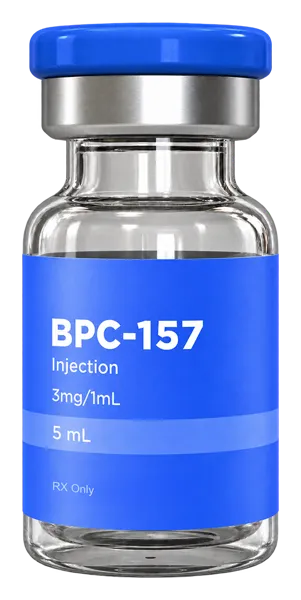
| Injectable BPC-157 | Injection in many rat models; in people, knee injections, bladder injections and an intravenous infusion | Mostly animal studies, plus three tiny uncontrolled human reports |
| Oral BPC-157 capsules | In drinking water in rat ligament and rat intestinal studies | Animal studies only; no published human study of an oral dose and no human absorption data |
| BPC-157 and TB-500 oral capsules | None for this combination by mouth | No direct studies; rests on each peptide’s separate, mostly animal evidence |
| Wolverine blend (BPC-157 and TB-500, injectable) | Injection in one 2026 rat Achilles study; 4 of the 16 knee-pain patients received BPC-157 with thymosin beta-4 | One exploratory animal study, which found no added benefit from combining them |
| Glow blend (GHK-Cu, BPC-157 and TB-500, injectable) | None for the blend | No direct studies; a PubMed search we ran in October 2026 for BPC-157 with GHK-Cu returned no study of the combination, only overview articles |
For the practical side of the capsule-versus-vial choice, including why the oral route has a plausible story but no human data, see BPC-157 oral vs injection.
Is BPC-157 safe? Side effects and safety unknowns
BPC-157’s human safety profile is largely unknown, because it has barely been studied in people. Marketing often calls it “well tolerated” or “side-effect-free,” and it is true that the preclinical literature reports relatively few adverse effects in animal models. In the three small human studies, no side effects were reported, though the knee-pain study did not describe how it screened for them, and together those studies include only about 30 people. A 2020 animal safety study cited in the same review could not identify a minimum toxic or lethal dose. But “few reported effects in rodents” is not a human safety record. The US Anti-Doping Agency states the situation plainly: because BPC-157 has not been extensively studied in humans, no one knows whether there is a safe dose, and it warns that the compound is experimental and may lead to negative health effects.
The theoretical concerns follow from how the peptide works. The 2025 musculoskeletal review lists pathologic blood-vessel growth, toxic metabolite formation and overproduction of nitric oxide as possible unwanted effects drawn from cell studies, noting that abnormal blood-vessel growth is implicated in tumor growth. The same review also cites preclinical work in which BPC-157 counteracted tumor-driven blood-vessel signaling, so the concern is unresolved rather than confirmed.
Layered on top of those biological unknowns is a product-quality problem specific to how BPC-157 is actually sold. Because it is not a regulated medicine, the vials shipped by online vendors carry none of the guarantees a pharmacy product does. As the expert review notes, the “third-party” certificates of analysis that vendors point to are often produced by the vendors themselves, and reliance on those certificates is itself an admission that the normal guardrails of identity, potency, sterility and quality control are absent. Independent laboratory testing shows this is not a hypothetical worry. When one quality-control analysis examined a synthetic research peptide sourced from five different manufacturers, it found that one of the products was, in reality, a completely different peptide and that two-thirds of the rest fell short of research-grade purity. The FDA has cited adverse immune reactions, peptide-related impurities, and insufficient safety information as safety concerns about BPC-157, the kind of impurities that stay invisible to whoever ends up injecting an unregulated vial. So the safety picture carries two layers of uncertainty at once: what the molecule does in a human body, and whether the vial even contains what the label claims. Our sister site’s BPC-157 side effects guide covers the full safety record.
Can you take BPC-157 with TB-500?
People do, and the pairing is popular enough to be sold premixed under names like “Wolverine” blend, but the combination has barely been studied. The only controlled test of the two together that we found is a 2026 rat study of repaired Achilles tendons, in which BPC-157, TB-500 and the combination were each compared with untreated controls. Both peptides were associated with better tendon structure, but combined treatment did not add any benefit over either peptide alone, and the authors called the work exploratory. A PubMed search we ran in October 2026 for BPC-157 together with TB-500 or thymosin beta-4 returned no human clinical trial. So the stack rests on the same animal evidence as each peptide, plus the community’s reasoning that two different mechanisms should add up.
| Question | BPC-157 alone | BPC-157 with TB-500 (Wolverine) |
|---|---|---|
| Animal evidence | Many rat studies across tendon, ligament, muscle, bone and gut | One 2026 rat Achilles study; no added benefit over either peptide alone |
| Human evidence | Three tiny uncontrolled reports | Four patients in one retrospective knee-pain chart review received BPC-157 with thymosin beta-4 |
| Randomized human trial | One registered, recruiting (hamstring strain) | None found |
For the head-to-head, see how BPC-157 compares with TB-500, our TB-500 overview, and the full explainer on the Wolverine stack.
Does BPC-157 help with weight loss?
No published study supports BPC-157 for weight loss. A PubMed search we ran in October 2026 for BPC-157 together with obesity, weight loss or body weight returned no study testing it as a weight-loss treatment in animals or people. The closest finding points the other way: the 2025 musculoskeletal review cites preclinical work in which BPC-157 attenuated tumor cachexia, the muscle- and weight-wasting seen in advanced cancer. Weight-loss claims for injectable peptides do circulate on social media, where influencers pitch compounds including BPC-157 and TB-500 as products that reduce wrinkles and “melt” belly fat, but that marketing is not backed by a weight-loss study of BPC-157.
How much does BPC-157 cost?
There is no standard price for BPC-157, because there is no manufacturer list price for a substance that is not an approved drug. Prices are set by individual sellers and vary with the form (injectable vial, capsule or premixed blend), the amount per vial and the supply length, so two listings are hard to compare even when the name is the same. Blends add another layer: a premixed vial of two or three peptides cannot be priced against BPC-157 alone unless you know how much of each it contains. Price is also a weak signal of quality. The expert write-up notes that the 98 percent purity figures vendors advertise would not meet any reasonable drug standards, so a cheaper vial and a pricier one are not two points on the same quality curve. Our network cost explainer explains why we do not publish a single price range for research peptides, and our sister site’s guide to BPC-157 prescriptions covers what dated listing prices include.
Is BPC-157 banned in sport?
Yes. BPC-157 is prohibited in sport under the World Anti-Doping Agency’s S0 category for non-approved substances, which covers compounds with no current regulatory approval for human use. Any athlete in a tested sport should treat it as banned at all times, in and out of competition. Sport rules are separate from FDA status, which PeptideAgent’s BPC-157 regulatory timeline tracks action by action, with sources.
What are people saying about BPC-157?
Recovery and gut repair dominate the BPC-157 conversation. Our community tracker’s runs between July 16 and 20, 2026 each analyzed 15 or 16 posts on X about BPC-157, largely the same posts surfaced for different network sites, and the themes were consistent:
- Injury and tissue repair. Users most often describe it as something they take for tendon, muscle and post-surgical recovery. One described starting it after a fracture and surgery, alongside TB-500. Posters differ a lot on how much of their recovery they credit to the peptide.
- Stacking with TB-500. Posters frequently describe TB-500 as the recovery peptide they pair with BPC-157 for tissue repair, the combination this page’s stack section examines. These are self-described routines, not evidence of effect.
- Gut health. Several users describe taking oral BPC-157 for gut repair and what they call leaky gut, sometimes as part of a wider routine for digestion and stress. Posters explain the choice by pointing to the peptide’s origin in gastric juice, which is how users justify it, not an established mechanism.
- Safety worries. The sharpest disagreement is over safety. One poster said they had found roughly 20 self-reported cancer-like adverse events and pointed to the peptide’s effect on blood-vessel growth (VEGF signaling, described in the mechanism section above) as a theoretical concern, while stressing that the number of users behind those reports is unknown. Another insisted the peptide is cheap and very safe. Neither side has controlled human data, which is the point the evidence section makes.
- Product quality. At least one poster framed preparation mistakes as a source of contamination, treating product handling as a safety issue rather than an efficacy one.
- Off-label experiments. A few users report applying it to skin or scalp. These are isolated single-user accounts with no consensus.
Reddit’s long-form threads show the same split between hope and doubt. Threads we track include an r/ACL post titled “An anecdotal review on the use of BPC (BPC-157)” and an r/Biohackers post titled “BPC-157/TB-500 combo 50 day usage review,” both personal accounts rather than measured outcomes. These posts are a small snapshot. They show why people reach for BPC-157, not whether it works. Our BPC-157 community page tracks the conversation as it changes.
How to think about BPC-157
If you are weighing BPC-157, the most useful move is to separate the chemistry from the claims. The chemistry is real and genuinely interesting, a stable 15-amino-acid peptide with real preclinical signals for tendon, gut and blood-vessel repair. The claims are mostly hope built on animal data, because the human trials that would confirm them have not been run. The safety picture is mostly blank, both for the molecule and for the quality of what is in a given vial.
If your actual goal is faster recovery from an injury, more resilient tendons and joints, or relief from a stubborn gut problem, start with that goal, ideally with a licensed clinician, who can weigh physical therapy, an approved medication, or a structured rehabilitation plan alongside anything you are reading about. If you are evaluating any source, our sister publication lists what to ask before you buy any peptide.
Status: Not FDA-approved; sold by some telehealth providers as a compounded prescription. An FDA advisory committee reportedly voted in July 2026 to recommend allowing pharmacies to compound it; nothing has changed yet. What this status means.
Educational information only, not medical advice. Every scientific statement on this page is sourced to the primary references linked above. Updated October 12, 2026.
Sources (13)
Advertising disclosure: links marked "Paid link" go to Bodybuilding Peptides (trybbpeptides.com), an affiliate destination, and The Treatment Report may earn a commission if you buy there. Our coverage is independent of that relationship, and nothing on this page is medical or legal advice.
 See it at Bodybuilding Peptides