Selank: what it is, what it does, and what the evidence shows

The short answer
Selank is a synthetic seven-amino-acid peptide developed in Russia from tuftsin, a fragment of an immune protein. People use it mainly for anxiety and focus, often with Semax. Its human evidence is a few small Russian trials, mostly compared with benzodiazepines rather than placebo, plus animal studies; it has not been studied for sleep.
Selank is one of the most-discussed peptides in the anxiety and nootropic corners of the internet, usually pitched as a way to get benzodiazepine-like calm without the sedation or dependence, and usually with the evidence caveats quietly dropped. This page puts them back. It explains what Selank actually is, what people use it for, what researchers have and have not shown, and then answers the questions people actually search (is it a nootropic, does it help sleep, how does it feel) with the studied answer first and community reports second, clearly labeled. Every research claim links to a primary source. It is educational only, and nothing here is medical advice. For how this compound fits the wider landscape of approved medicines and unapproved research peptides, start with our cross-therapy explainer on what peptides are.
What is Selank?
Selank is a synthetic heptapeptide, a chain of seven amino acids, and it is best understood as an engineered version of a molecule the immune system already makes. Its core is tuftsin, the short Thr-Lys-Pro-Arg fragment of the immunoglobulin G heavy chain, which researchers extended at one end with three more amino acids. A 2016 study in Frontiers in Pharmacology describes it precisely: Selank is a synthetic analog of the endogenous tuftsin molecule, elongated at the C terminus via the addition of three natural L-amino acids (Pro-Gly-Pro). That small addition is not cosmetic. Tuftsin on its own breaks down almost immediately in the body, and the Pro-Gly-Pro tail is what gives Selank enough stability to behave like a drug candidate rather than a fleeting signal; a 2010 rat study describes the result as stable with respect to tissue peptidases, the enzymes that chop peptides apart.
The second thing to know is where it comes from. Selank is not a Western pharmaceutical; it was designed and produced at the Institute of Molecular Genetics, Russian Academy of Sciences, in cooperation with the V.V. Zakusov Research Institute of Pharmacology. Almost the entire body of research on it comes from Russian institutions, and it is usually administered as a nasal spray rather than an injection. It is also not a steroid, not a growth-hormone peptide, and not one of the muscle or recovery compounds it is sometimes shelved next to online; it is a neuropeptide aimed at the brain. For the most-searched research peptide and how these overview pages are structured, our BPC-157 overview is the companion entry in this directory.
How is Selank thought to work?
Selank is thought to work by nudging several of the brain’s own signaling systems at once rather than hitting a single receptor, though almost all of the detailed mechanism comes from animal and cell studies. The most cited pathway is the GABA system, the brain’s main inhibitory or calming network. In a rat study published in Behavioural Neurology, researchers reported that Selank not only modulates GABA-A receptors allosterically but also increases the affinity of DZ (diazepam) to these receptors, the same class of receptor that benzodiazepines act on. That overlap is the basis for the constant comparison between Selank and benzodiazepine tranquilizers.
Beyond GABA, the proposed picture widens. The Frontiers in Pharmacology group found that a single dose of Selank shifted the expression of a large set of neurotransmission genes in the rat frontal cortex: 45 genes showed changes in mRNA level 1 hour after Selank administration, with 22 still altered at three hours, spanning GABA, serotonin, and dopamine machinery. A separate strand of work points to the body’s own opioids. A 2022 rat study describes Selank as a peptide analog of tuftsin and attributes part of its activity to an inhibiting effect on the enzymes that break down enkephalins, which would prolong the action of those natural mood- and pain-regulating molecules. The honest framing is that these are plausible, biologically detailed mechanisms observed mostly in rodents and cells, not confirmed pathways of benefit in a living person. When marketing says Selank acts on GABA like a benzodiazepine but without the drawbacks, the receptor evidence behind that sentence is largely a rat model.
What does Selank do, and what is it used for?
Selank is used and studied mainly for two goals: reducing anxiety and sharpening cognition, with fatigue a smaller third. It is important to read those as areas of active investigation rather than proven uses, because the language of a product listing (“benzo-level calm, no dependence”) and the language of the science (“changed an anxiety measure in a rat, or matched a comparator drug in a small trial”) are not the same claim. On the anxiety side, the interest centers on generalized anxiety and stress-related complaints; on the cognitive side, it clusters around attention, mental stamina, and mood, often tied to the peptide’s reported effect on BDNF, a protein involved in learning and neuroplasticity.
Because this overview is the definitional entry point, the network’s deeper, evidence-first pages examine each claimed area rather than asserting it here:
- Anxiety and stress: our sister publication on what the Selank anxiety and stress-response research actually shows.
- Cognition and focus: whether nootropic peptides actually improve focus beyond the marketing.
- Compared with its sibling peptide: how Selank compares with Semax, the other Russian-developed neuropeptide it is most often paired with, and our own Semax overview.
- The format most people buy: what is known about Selank nasal spray and why the research leaned on it.
Treat every one of those areas as “being investigated,” not “established.” The marketing describes the outcomes people hope for; the evidence section below describes what has actually been demonstrated, and the gap between the two is the reason this page exists.
What does the evidence actually show?
The human evidence for Selank is limited and comes almost entirely from Russia, and the most-cited trial did not test it against a placebo. That trial, published in a Russian neurology and psychiatry journal in 2008, enrolled 62 patients with generalized anxiety disorder and neurasthenia, giving 30 of them Selank and 32 the benzodiazepine medazepam. The authors reported that the anxiolytic effects of both drugs were similar, but selank had also antiasthenic and psychostimulant effects. That is a genuinely interesting result, but notice what it is and is not: it shows Selank performing comparably to an active benzodiazepine comparator, not that it separated from an inactive placebo, which is the harder and more informative test. Matching a comparator in a small trial clears a much lower bar than beating placebo in a large blinded one.
Two later Russian trials follow the same pattern. A 2014 study of 60 patients with phobic-anxiety and somatoform disorders compared Selank with the benzodiazepine phenazepam and reported pronounced anxiolytic and mild nootropic effects, with the calming effect lasting for a week after the last dose. A 2015 study gave 30 patients phenazepam alone and 40 patients phenazepam plus Selank, and reported that the combination brought the benzodiazepine’s effect on earlier and reduced several of its side effects. Neither had a placebo arm, and all three trials share authors from the same research network. In words, the human evidence level is: a few small comparator trials from one country, no large placebo-controlled trial.
The preclinical literature is larger and more consistent, but it is still preclinical. In the chronic-stress rat model noted above, researchers concluded that the combination of diazepam with Selank was the most effective in reducing anxiety under unpredictable chronic mild stress. In the opioid-withdrawal model, a single dose of Selank reduced the total index of morphine withdrawal syndrome by 39.6% in rats. These are real findings in animals, and they are the kind of signal that justifies more study, but they are not evidence of a defined benefit in humans.
It is also worth showing where the story gets more complicated, not only the flattering parts. When researchers tried to reproduce Selank’s gene-expression effects in a human cell line, the result did not carry over cleanly: in cultured human neuroblastoma (IMR-32) cells, they found no changes in the mRNA levels of the genes studied under the effect of Selank on its own. Effects seen in a living rat brain did not simply reappear in a dish of human cells. That does not disprove the mechanism, but it is a reminder of how far the science still is from a clean, confirmed account of what Selank does in people. Across the board, Selank sits far more on the promise side than the proof side, and no large completed randomized, placebo-controlled trial establishes efficacy for the anxiety or cognitive uses it is marketed for. Preclinical promise and human proof are different things, and anyone presenting a rat result or a comparator-only trial as settled human efficacy is skipping the step that matters most.
What are the benefits of Selank?
The benefits of Selank that researchers have actually measured are narrower than the ones it is sold on, and several were measured only in rats. Here is each one with its evidence level in words:
- Less anxiety. The best-supported benefit. Three small Russian trials reported anxiety relief similar to a benzodiazepine (2008), pronounced anxiolytic effects in a comparison with one (2014), or a faster response when Selank was added to one (2015). Evidence level: small human trials against active drugs, no placebo.
- Less fatigue. The 2008 trial reported antiasthenic and psychostimulant effects, meaning less of the exhaustion that comes with neurasthenia. Evidence level: one small human trial.
- Fewer benzodiazepine side effects. In the 2015 add-on trial, adding Selank reduced phenazepam’s attention and memory impairment, asthenia, sedation, increase in sleep duration and several other unwanted effects. Evidence level: one small human trial.
- Memory. In rats, a single injection given during learning produced an increase in memory trace stability during 30 days, and intranasal Selank regulates BDNF expression in the rat hippocampus, a growth factor tied to learning. Evidence level: animal studies.
- Easing opioid withdrawal. The 39.6% reduction in morphine withdrawal described above. Evidence level: one rat study.
Three benefits that circulate online have no measured support yet: better sleep (see below), sharper focus in healthy people, and “no dependence,” which nobody has tested in people (see the withdrawal section).
Selank nasal spray, injection, or the Semax and Selank combination?
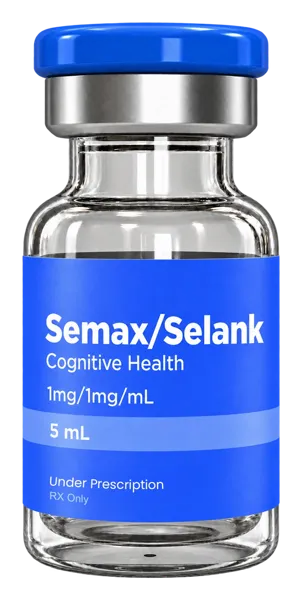
The nasal spray is the form the research leaned on, injection was used mostly in animal studies, and we found no published trial of Semax and Selank taken together. In a rat study that tracked radioactively labeled Selank after four different routes, the authors concluded that intranasal dosing was optimal for the delivery of glyproline molecules in the CNS, and PubMed indexes the 2008 human trial under intranasal (as well as oral) administration. A 2016 mouse study found both routes calming, but only in an anxious strain, and with different brain chemistry: injection raised GABA receptor binding in the frontal cortex by 38%, while the nasal route led to an increase in the density of NMDA receptor binding sites in the hippocampus by 23% instead. For the pairing, the closest human study gave 52 healthy people either Semax, or Selank, or placebo in separate groups and measured brain connectivity on scans, not anxiety or focus. Both injectable powders and nasal sprays are sold online; a Belgian lab that identified Selank and Semax in two seized preparations noted that, to its knowledge, these peptides have not completed any clinical trials. As listed on October 12, 2026, the Semax and Selank combination at Bodybuilding Peptides is an injectable vial, and its Selank nasal spray is a separate product.
| Selank nasal spray | Selank injection | Semax + Selank combination | |
|---|---|---|---|
| Route used in the research | Intranasal; PubMed also lists oral for 2008 | Injection into the abdomen, in rat and mouse work | Each peptide studied on its own |
| Brain delivery (rat tracer study) | Best of the four routes tested | Lower than intranasal | Not studied |
| Human studies | Small Russian anxiety trials | None found comparing it with the spray | No combination trial found |
| Evidence level in words | Small human trials plus animal studies | Mostly animal studies | Rationale only, from two separate profiles |
| What community posts describe | Format not a theme in our sample | Not a theme in our sample | Semax for focus, Selank for calm |
The community row summarizes our tracker’s posts on X (July 2026) and is not evidence. For the format in more depth, see Selank nasal spray; for the pairing, Selank vs Semax.
Is Selank a nootropic?
Partly. In the research Selank is an anti-anxiety peptide first, with nootropic effects reported as a secondary finding, and the stronger memory data come from rats. The 2014 trial described its nootropic effect in patients as mild, and the rat study above found longer-lasting memory after a single dose given during learning (Semenova et al., 2010). A PubMed search we ran on October 12, 2026 for Selank in healthy volunteers turned up one study, the 2020 brain-scan study, which measured connectivity rather than focus or memory (Panikratova et al., 2020). So the honest label is “anxiolytic with some nootropic signal in animals and patients,” not a proven focus drug.
What users report. In the community, Selank mostly earns the nootropic label through its partner. Posts in our Semax tracker describe Semax as the peptide people take for focus, our Selank posts describe pairing Selank with it for anxiety support, and some list both inside larger nootropic stacks. That is user framing of the two peptides, not a measured effect.
Does Selank help sleep?
Nobody has studied it, so the answer is unknown, and the little indirect data point away from sleepiness. A PubMed search we ran on October 12, 2026 for Selank and sleep returned three records; none tested Selank as a sleep aid. The 2008 trial described Selank as having psychostimulant effects, and in the 2015 add-on trial a longer sleep duration was one of the benzodiazepine side effects that adding Selank decreased. Neither is a sleep study, but neither suggests Selank makes people sleep more.
What users report. Sleep was not a main theme in our Selank posts. In our tracker’s posts on DSIP (9 posts on X, July 2026), some users described pairing DSIP with Selank in routines aimed at sleep, stress and recovery, and reported experiences with those combinations differed. That is a stack people try, not a tested one. For what is known about the sleep peptide itself, see DSIP for sleep: what is studied.
How do you feel on Selank?
The trials did not ask people how Selank feels; they measured anxiety rating scales, so the studied answer is indirect. The 2008 trial reported calming effects similar to medazepam plus antiasthenic and psychostimulant effects (Zozulia et al., 2008), which reads closer to “calmer and less worn out” than “sedated,” and the 2014 trial reported that the calming effect lasted for a week after last receiving the peptide. These were patients with anxiety disorders, so they say little about how a healthy person would feel.
What users report. The most common description in our Selank posts is feeling calmer without drowsiness, the “anxiolytic with no sedation” framing, and one poster called it a personal life saver. Our tracker rated the tone as mostly positive with a skeptical minority, and flagged that rating as an impression from a small sample. Not every account is good: one r/Nootropics thread we track asks, in its title, whether anyone else got an “anxious ADHD feeling” on day 3. These are individual reports, not measured outcomes.
Which is the best peptide for anxiety?
This page cannot name an evidence-based “best,” because the research we reviewed for it includes no large placebo-controlled trial of a peptide for anxiety. Selank’s case rests on three small Russian trials against or alongside benzodiazepines plus animal work, which makes it a research question rather than a first-line answer. Anxiety has well-studied treatments, and a licensed clinician can match one to the cause. For the Selank anxiety research in detail, see Selank and the stress response.
What are the reported side effects and safety unknowns?
Selank’s human safety profile is not well characterized, because it has been studied in relatively few people and almost entirely within a single national research tradition. In the Russian trials it has generally been described as well tolerated, and the mechanistic reviews note that its effect is similar to that of tranquilizers at low doses, but is not accompanied by the unwanted side effects of benzodiazepine tranquilizers such as heavy sedation and dependence. That is an encouraging observation, but “well tolerated in a small supervised study” is not the same as a mapped safety profile, and there is little independent, long-term, or large-scale safety data to confirm it. The absence of reported harm in a thin literature is not the same as evidence of safety.
Layered on top of the biological unknowns is a product-quality problem specific to how research peptides are actually sold. A vial labeled “research use only” sits outside medicine regulation, so it is not required to be sterile, to contain the dose printed on the label, or to be free of contaminants. Forensic testing shows this is not a hypothetical worry. A 2018 study in Talanta analyzed falsified peptide drugs acquired from suspected illegal internet pharmacies and found purity for some peptides ranging between 5% and 75%, wide variation in the amount of drug per unit, and toxic elemental impurities including arsenic at concentrations up to ten times the ICH toxicity limit for parenteral drugs. For a compound most people take by nasal spray or injection, that stacks two uncertainties at once: what the molecule does in a human body, and whether the vial even contains what the label claims, at the purity and sterility such a route of administration demands. Our companion explainer on what the evidence shows about peptide side effects walks through both the documented risks of approved drugs and the unknowns of the research compounds.
Does Selank cause withdrawal or dependence?
Nobody has measured it properly in people, so neither “no withdrawal” nor “risky withdrawal” is established. The Russian-led literature describes Selank’s effect as similar to that of tranquilizers at low doses, but not accompanied by the unwanted side effects of benzodiazepine tranquilizers, which is where the “no dependence” claim comes from. A 2021 review by US clinical pharmacologists is more cautious: it groups Selank with other GABA-acting drugs, calls it poorly studied, and says agents with GABA properties should be evaluated for abuse potential before public access. A PubMed search we ran in October 2026 for Selank with withdrawal or dependence found animal studies of Selank easing withdrawal from other drugs, such as the morphine study above, but no human study of what happens when people stop taking Selank itself.
What are people saying about Selank?
Selank has one of the more positive communities among the peptides we track. In 9 posts on X that our community tracker collected between July 17 and 19, 2026, the main threads were:
- Anxiety first. Anxiety relief is the most cited reason people take it. Some users say it helped them, and one called it a personal life saver. Several referred to the Russian trial that compared it with a benzodiazepine.
- Calm without sedation. A recurring point is that users feel calmer without the drowsiness they associate with other calming drugs, the “anxiolytic with no sedation” framing. That matches the claim in the Russian literature, but it is user description, not a measured outcome.
- Stacked with Semax. Many users pair it with Semax, describing Semax for focus and Selank for calm, sometimes inside larger stacks.
- How it works, in users’ words. Posters describe it as a tuftsin analog acting on GABA and enkephalins and as a tool for a dysregulated stress response, which echoes the proposed mechanisms above rather than adding new evidence.
These are a handful of self-reports from one platform over three days, not evidence that Selank works or is safe. They do show what draws people to it: the hope of calm without the costs of a benzodiazepine.
How to think about Selank
If you are weighing Selank, the most useful move is to separate the chemistry from the claims. The chemistry is real and genuinely interesting, a stable seven-amino-acid relative of a natural immune peptide with detailed, multi-system signaling seen in the lab. The claims are more hope than proof, because the human evidence is a small set of mostly Russian trials, several measured against a benzodiazepine rather than a placebo, and even the mechanism does not always reproduce when it moves from a rat brain to human cells.
If your actual goal is bringing persistent anxiety, stress, or trouble concentrating under better control, start with that goal, ideally with a licensed clinician, because anxiety has well-studied treatments and a professional can rule out other causes. For how Selank compares with its sibling peptide, see Selank versus Semax on our cognition site.
Status: Not FDA-approved; sold by some telehealth providers as a compounded prescription. What this status means.
Educational information only, not medical advice. Every scientific statement on this page is sourced to the primary references linked above. Updated October 12, 2026.
Sources (15)
Advertising disclosure: links marked "Paid link" go to Bodybuilding Peptides (trybbpeptides.com), an affiliate destination, and The Treatment Report may earn a commission if you buy there. Our coverage is independent of that relationship, and nothing on this page is medical or legal advice.
 See it at Bodybuilding Peptides