Melanotan II (MT2): what it is, how people use it, and what the evidence and risks show

The short answer
Melanotan II (MT2) is a synthetic melanocortin-receptor agonist, a lab-made cyclic analogue of the hormone that controls skin pigment. People use it as an injectable tanning shortcut and, separately, as a libido aid. It is not an approved medicine, and its rigorous human evidence is thin, limited to a few small early studies of pigmentation and erections. Its documented harms are why this page leads with safety: nausea and vomiting, spontaneous erections and priapism (a medical emergency), blood-pressure and heart-rate changes with reported cases of systemic toxicity and muscle breakdown, and changes to moles that raise a melanoma-surveillance concern. Dermatology bodies warn against it.
Melanotan II is a synthetic peptide that switches on the body’s pigment machinery, and it is sold online as an injectable shortcut to a tan and, separately, as a libido aid. Users often call it MT2. It is not a tested medicine. The honest version of this page leads with the part the marketing buries: Melanotan II is not approved for any use, its rigorous human evidence is thin, and its documented harms are serious enough that safety, not benefit, is the center of everything below. This overview explains what Melanotan II actually is, how it is thought to work, what the evidence does and does not show, and what is known about its risks, with a primary source for every claim. It is educational only, and nothing here is medical advice. For how this compound fits the wider world of approved drugs and unapproved research chemicals, start with our cross-therapy explainer on what peptides are.
What is Melanotan II?
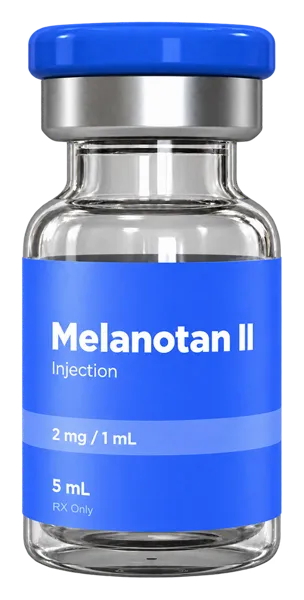
Melanotan II is a synthetic, cyclic analogue of alpha-melanocyte-stimulating hormone (α-MSH), the small signaling molecule that tells pigment cells to make more melanin. Chemically it is a lab-made peptide built to hit the same family of receptors that natural α-MSH does, but more potently and for longer. It is not something the body produces in this form; it is a designed molecule, and it is sold almost entirely as an injectable “research use only” product rather than as a licensed medicine. Vendors also market a nasal-spray version, but the underground standard is a subcutaneous injection.
Two points clear up most of the confusion around it. First, Melanotan II is often conflated with “Melanotan I,” a closely related but distinct analogue; the two are not interchangeable (our Melanotan 1 vs Melanotan 2 page lays out the differences), and this page is specifically about Melanotan II. Second, and more important, the “research use only” label is not a quality grade or a wellness endorsement. It is a disclaimer that the product has not been approved for use in people and is nominally being sold for laboratory purposes, which is exactly the posture that lets an unapproved drug move through consumer channels. For the most-searched research peptide and how these directory overviews are structured, our BPC-157 overview is the companion entry in this network.
How is Melanotan II thought to work?
Melanotan II works by imitating α-MSH at the body’s melanocortin receptors, and the two effects that built its underground market trace to two different receptors in that family. At the melanocortin-1 receptor on pigment cells, it drives melanogenesis, the production of the dark pigment melanin, which is the basis of the “tan” it is sold for. In the University of Arizona pilot study that first tested the peptide in people, subjects developed increased pigmentation of the face, upper body, and buttocks, measured by quantitative reflectance, after a short course of injections.
At the melanocortin-4 receptor in the brain, the same peptide influences sexual arousal, which is the second effect it is marketed for. That effect is not folklore. In a small 1998 double-blind, placebo-controlled crossover study, the synthetic melanotropic peptide initiated clinically apparent erections in 8 of 10 men with erectile complaints, and the earliest pilot noted that a stretching-and-yawning response tracked the onset of spontaneous erections. The honest framing is that these are real pharmacological actions observed in very small, early studies, not a fully mapped, dose-defined, safety-characterized mechanism of the kind an approved drug carries. The receptors it engages sit throughout the body, which is also why its effects, and its harms, reach well beyond the skin.
What is Melanotan II studied and marketed for?
Melanotan II is marketed, and to a very limited degree was studied, for two goals: darker skin with less sun, and heightened sexual arousal or erectile response. It is important to read these as marketing claims resting on thin early research, not as established uses, because the phrasing of a vendor listing (“a fast, natural-looking tan”) and the phrasing of the science (“a three-person pilot measured increased pigmentation”) point at very different things. The melanocortin system that Melanotan II hits is a legitimate drug target, which is worth stating plainly to avoid the opposite error of pretending the chemistry is fake.
A related melanocortin agonist shows what a tested, approved version of this chemistry looks like. Bremelanotide, sold as Vyleesi and also known as PT-141, is approved by the FDA for one narrow use, acquired and generalized low sexual desire (HSDD) in premenopausal women. Melanotan II is not that drug. It is a different molecule that has never cleared that bar for any purpose, and comparing the two is instructive precisely because it shows the gap between a compound that went through the approval process for a defined indication and one that did not. Our sister publication covers the approved melanocortin route in its explainer on PT-141 for women. Treat the tanning and libido uses of Melanotan II itself as marketed and lightly investigated, never as demonstrated or safe.
What does the evidence actually show?
The rigorous human evidence for Melanotan II is thin, and what exists comes from a handful of small, early studies rather than the large controlled trials that define a medicine. The pigmentation data trace largely to a three-subject pilot phase-I study from 1996 and closely related early work, and the sexual-response data to small crossover studies of ten or fewer men. Those studies were designed to probe a mechanism over days or weeks, not to prove that self-dosing the peptide for cosmetic tanning or performance is effective, let alone safe over months and years.
There is no large, completed, published randomized trial establishing that Melanotan II is safe or effective for the tanning and libido uses it is sold for. A 2017 review in the International Journal of Dermatology, a widely cited independent assessment of these compounds, frames the unregulated melanotans as untested synthetic analogues whose unregulated use is accumulating case reports of harm, and it notes that the only α-MSH analogue thoroughly tested and deemed safe is a different molecule, not Melanotan II. So the picture is lopsided in a specific way: the promise rests on early mechanism studies and marketing, while the proof that would make it a medicine, and characterize its risks, has never been generated. That imbalance is not a technicality. It is the reason both regulators and dermatologists treat the compound as experimental rather than established.
What are the reported side effects and safety concerns?
Melanotan II’s documented harms are wide-ranging, and several are serious, which is why safety is the center of this page. The mildest and most common, seen even in the earliest supervised studies, are nausea, facial flushing, and spontaneous yawning and stretching, along with the decreased appetite reported in the erectile-response crossover; vomiting is also frequently reported by users. On their own these are unpleasant rather than dangerous, but they are a reminder that the peptide acts across the whole body, not just on the skin.
The sexual effect that vendors sell as a feature is also a recognized emergency. Because Melanotan II activates the same melanocortin pathway that initiates erections, it can produce erections that do not resolve. A published case report documents Melanotan II overdose associated with priapism. Priapism, an erection lasting more than four hours, is a urological emergency: without prompt treatment it can permanently damage erectile tissue. This is not a rare quirk of the molecule, it is a predictable consequence of what melanocortin-4 activation does, and it is one of the clearest examples of a marketed “benefit” and a medical harm being the same effect.
More alarming are the systemic reactions. In one documented case, a man who injected a large dose of Melanotan II developed a sympathomimetic reaction, a heart rate peaking at 146 beats per minute, and rhabdomyolysis, with a creatine kinase that climbed to nearly 18,000 and evidence of kidney injury, requiring intensive-care treatment. Blood-pressure and heart-rate changes are part of the melanocortin system’s normal reach, and in an unregulated product with no reliable dose, the line between a “tanning” amount and a toxic one is exactly the line an unregulated vial erases.
The concern that worries dermatologists most is what Melanotan II does to moles. The 2017 International Journal of Dermatology review found that unregulated melanotan use is associated with changes in existing moles and the appearance of new, sometimes dysplastic, moles, and that four separate case reports describe melanomas emerging from existing moles during or shortly after melanotan use. A 2014 report in the journal Dermatology describes a melanoma in a 20-year-old woman after a course of Melanotan II self-injection combined with tanning-bed use. The problem cuts two ways: a drug that darkens and multiplies pigmented lesions can both raise questions about the lesions themselves and make the moles that need watching harder to read, which is a genuine melanoma-surveillance concern. No study has proven that the peptide itself triggers melanoma, but the surveillance problem holds regardless of cause, and the Skin Cancer Foundation warns against Melanotan II and points people to sunless self-tanners instead.
Layered on top of every biological risk is a product-quality problem. Because Melanotan II is sold “research use only,” a vial carries none of the guarantees a pharmacy medicine does: no assurance it is sterile, that the dose on the label matches the contents, or that it is free of contaminants. The same 2017 review flags exactly these uncertainties of preparation, administration, and dosage as core reasons the unregulated melanotans are risky. So the safety picture stacks two unknowns at once: what an under-studied, body-wide peptide does inside a person, and whether the vial even contains what the label claims, at the purity and sterility an injection demands. Our companion explainer walks through what the evidence shows about peptide side effects, and our sister publication covers what to ask before you buy any peptide.
How does Melanotan II compare with Melanotan I and afamelanotide?
They are relatives with very different track records. The 2017 dermatology review notes that unregulated users take both melanotan I and II, mainly for their tan-stimulating effects, and that case reports of mole changes involve both. The one analogue in this family with an approval is afamelanotide, which the same review describes as the only alpha-MSH analogue approved for a limited number of medical uses. In the United States it is sold as Scenesse, a slow-release implant approved in 2019 to increase pain-free light exposure in adults with erythropoietic protoporphyria, a rare light-sensitivity disorder, not for cosmetic tanning. Even that tested product carries a skin warning: its label says it may darken existing moles and freckles and recommends a full-body skin examination twice a year. Melanotan II acts on more melanocortin receptors than afamelanotide’s target, which is why it also affects appetite, nausea and erections, and it has none of that testing behind it. For a fuller side-by-side of the two melanotans, see our Melanotan 1 vs Melanotan 2 comparison.
Why is Melanotan II popular?
The short answer is tanning culture. The dermatology review stresses that melanotan has become part of a “tanning culture” in certain groups, and that multiple national health organizations have issued safety warnings about it. The appeal is easy to see: a darker tan with less sun exposure, plus the libido effect it is also sold for. The risks described above are the other side of that same pitch.
How to think about Melanotan II
If you are weighing Melanotan II, the most useful move is to separate three things the marketing blends together: the chemistry, the claims, and the risk. The chemistry is real, a potent melanocortin agonist that genuinely darkens skin and genuinely acts on arousal pathways. The claims are thin, resting on a few tiny early studies and a lot of forum testimony rather than the trials that would prove either benefit or safety. And the risk is not hypothetical: nausea and vomiting, priapism, sympathomimetic toxicity and muscle breakdown at higher doses, and mole changes that sit directly across a melanoma-surveillance concern, all delivered by a vial of uncertain contents. Holding those three facts together is the honest starting point, and it is the opposite of what a “get a tan from a syringe” pitch invites.
If your actual goal is a tan, the safer routes are the boring ones: sunless self-tanning products and sensible sun protection, which is precisely what dermatology bodies recommend in place of injectable tanning drugs. Because the documented concern centers on mole changes, anyone who has used it has good reason to have their moles checked by a dermatologist. If your goal is around sexual desire or function, that is a real medical question with tested, approved options, such as the bremelanotide described above for its one labeled use, and a licensed clinician can weigh what fits your situation.
Status: Not FDA-approved for any use. What this status means.
Educational information only, not medical advice. Every scientific statement on this page is sourced to the primary references linked above. Updated October 12, 2026.
Sources (9)
Advertising disclosure: links marked "Paid link" go to Bodybuilding Peptides (trybbpeptides.com), an affiliate destination, and The Treatment Report may earn a commission if you buy there. Our coverage is independent of that relationship, and nothing on this page is medical or legal advice.
 See it at Bodybuilding Peptides