GHK-Cu: the copper peptide that lives two lives, skincare staple and injectable trend
The short answer
GHK-Cu is a small copper-binding peptide (glycine, histidine, lysine) found naturally in human blood, where levels fall with age. As a skincare ingredient it has decades of use and a handful of small human cream studies reporting firmer, less wrinkled skin. Injecting it is a newer social-media trend with no published human safety or efficacy data.
GHK-Cu is really two conversations that happen to share a name. One is a quiet, decades-old skincare story: a copper peptide in serums and creams, backed by a modest stack of small human studies. The other is loud and recent: people drawing the same molecule into syringes because a glow-up thread told them to. NPR’s September 2026 coverage described the trend as having moved from creams to injections, ahead of the science. This overview keeps the two apart: what the skin research shows, what is (and is not) known about injecting it, the side effects, and what people are actually saying. It is educational only, not medical advice. If you are new to the category, start with what peptides are.
What is GHK-Cu?
GHK-Cu is a three-amino-acid peptide, glycyl-L-histidyl-L-lysine (GHK), bound to a copper ion. It is not a lab invention: GHK occurs naturally in human plasma, saliva and urine. A 2015 review reports plasma GHK at about 200 ng/mL at age 20, falling to 80 ng/mL by age 60, and the peptide grabs copper so strongly that it readily forms the GHK-Cu complex.
The molecule was first isolated in 1973 by chemist Loren Pickart, who noticed that something in human blood made old human liver tissue synthesize proteins like younger tissue. NPR’s account adds that he compared blood from medical students with blood from their older professors and found levels decline as people age. That “youth factor that fades” framing is a big part of why the molecule markets so well.
Two naming notes save confusion. “GHK” is the bare peptide and “GHK-Cu” is the copper complex; most products and most studies mean the copper form. And “copper peptides” on a skincare label often means GHK-Cu, but related copper peptides exist (AHK-Cu, covered in the hair section below, is one), so the label is worth reading.
What does GHK-Cu do?
GHK-Cu acts as a signal for skin repair: in cell and animal studies it stimulates collagen and related structural molecules, attracts repair cells, and calms some inflammatory signals. The best-documented findings are in fibroblasts, the cells that build skin’s support structure. A 2015 review describes GHK-Cu at very low, nanomolar concentrations stimulating both synthesis and breakdown of collagen and glycosaminoglycans, which reads less like “more collagen” and more like “faster remodeling.”
The same review reports that in cultured skin cells, copper complexes of GHK reduced TNF-alpha induced secretion of the inflammatory cytokine IL-6, and that animal studies in rabbits, rats, mice, pigs and dogs found faster wound healing. A later review from the same group lists claimed effects running from tighter skin to increased hair growth and thickness.
Read those lists with one fact in mind: both of those reviews were written from the R&D department of Skin Biology, a company, with Pickart as lead author. That does not make the findings wrong, but it is a reason to weight the independent work below more heavily. The “resets 4,000 genes” claim you will see repeated online comes from these reviews’ analysis of a gene-expression database, a computational signal rather than a measured outcome in people.
What is GHK-Cu used for?
GHK-Cu is used in three ways, and the evidence behind each is very different:
- Topical skincare (the long-running use). Serums, creams and eye creams aimed at fine lines, firmness, texture and “skin quality.” This is where nearly all the human data sits.
- Hair products. Scalp serums marketed for thicker hair, resting mostly on lab and animal work.
- Injection (the new use). Subcutaneous injections, often stacked with recovery peptides such as BPC-157 and TB-500, promoted on social media for glow, skin, hair and general “anti-aging.” NPR describes the molecule as a staple of looksmaxxing content and notes it is sometimes “stacked” with other peptides promoted for tissue repair.
Our sister publication covers the skincare side in depth in GHK-Cu copper peptides for skin. This page is the overview that connects the three.
What does the skin research actually show?
The human evidence for topical GHK-Cu is real but thin: a handful of small studies, several never published in full, mostly funded by the cosmetics industry, with no large phase 3 trial in any indication. Evidence level, in words: small human cosmetic studies on top of a large body of cell and animal work.
The headline studies, as described in the reviews:
- Facial cream, 71 women, 12 weeks. Reported increased skin density and thickness, reduced laxity, improved clarity, and fewer fine lines.
- Eye cream, 41 women, 12 weeks. Reported to have performed better than placebo and vitamin K cream on lines, wrinkles and skin density.
- Thigh-skin biopsy comparison. Collagen production rose in 70% of women using GHK-Cu, versus 50% with vitamin C cream and 40% with retinoic acid.
- Nano-carrier serum, 8 weeks. A randomized, double-blind study reported a 55.8% reduction in wrinkle volume versus control serum.
Now the caveats, which come from an independent August 2026 systematic review out of Western University of Health Sciences. It notes that the much-cited 71-woman and 41-woman “trials” were published only as conference abstracts and have not appeared in full peer-reviewed form, that the 8-week wrinkle study had a small sample, and that there is no peer-reviewed phase III RCT of GHK-Cu in any human indication. It also describes a small randomized trial after CO2 laser resurfacing in which blinded evaluators found no difference in wrinkles, redness or skin quality, even though patients using the GHK-Cu products reported higher satisfaction.
A separate 2025 review in BioImpacts reached a similar place: on cell studies GHK “can be considered as an anti-wrinkle ingredient,” but there is a surprising absence of clinical studies using GHK-Cu, and getting it through the skin is a real formulation problem. NPR’s reporting matches: the controlled human studies are generally small trials funded by the cosmetic industry. One dermatologist NPR interviewed still called the science solid and put GHK-Cu on par with topicals like vitamin C.
Wound healing tells the same mixed story. A multicenter, randomized, placebo-controlled trial in diabetic plantar ulcers reported 98.5% median area closure with a GHK-Cu gel versus 60.8% for vehicle, on top of standardized wound care. But a randomized trial in venous leg ulcers found a 0.4% tripeptide-copper cream no better than placebo.
What about hair?
Hair claims for copper peptides rest mainly on lab and animal work. The human data are thin: the 2026 systematic review describes a 2025 case series that delivered copper peptides together with minoxidil and dutasteride, a design it says cannot isolate the GHK-Cu effect. A 2007 paper sometimes cited for hair, on human hair follicles grown in a dish, actually tested AHK-Cu, a related copper tripeptide, which lengthened follicles ex vivo, not GHK-Cu itself. The 2026 systematic review lists androgenetic alopecia as an indication that needs a properly designed human trial, compared against minoxidil. For more, see our sister site’s look at whether copper peptides help hair growth.
Is injectable GHK-Cu studied in humans?
No. There are no published human studies showing that injecting GHK-Cu is effective or safe for skin, hair or anything else. NPR put it plainly: there is no data from published human studies to show this practice is safe and effective. The injection idea leans on animal studies, described in the company-authored 2015 review, where GHK was injected and induced systemic wound healing in rats, mice, and pigs, plus the argument that topical GHK-Cu struggles to get through skin.
That second point is the injectable crowd’s strongest card, and it is partly fair. The 2026 review says the peptide is hydrophilic and charged, so passive diffusion across intact stratum corneum is poor. One dermatologist told NPR there could be added benefit from injecting for exactly that reason, while still advising patients to hold off until human studies exist. A clinician who offers GHK-Cu told NPR that in his experience the topicals work much better for skin and hair growth and injections tend to have minimal impact. That is one practitioner’s impression, not data, but it cuts against the trend’s core promise.
Is GHK-Cu safe? Side effects and who should be cautious
Topically, GHK-Cu has been sold in serums and creams for decades; injected, its safety in people is simply unstudied. The company-authored 2015 review states that no issues have ever arisen in its cosmetic or wound-healing use, which is a strong claim from an interested party. The independent evidence is less glowing in one specific spot: in a 2025 split-face acne-scar trial, the authors flagged a hyperpigmentation risk in the GHK-Cu arm. Injection raises different questions:
- Immune reactions and impurities. FDA’s compounding safety page says compounded injectable GHK-Cu may pose risk for immunogenicity due to the potential for aggregation and peptide-related impurities, and that limited human data exist to judge safety.
- Copper load. GHK-Cu carries copper. NIH’s Office of Dietary Supplements notes that chronic exposure to high levels of copper can result in liver damage. A clinician quoted by NPR described patients who self-injected and came in with elevated liver enzymes and elevated copper after injecting far too much; NPR noted it is unclear whether the copper peptide or other undisclosed substances or impurities were responsible.
- Product identity. A dermatologist told NPR, “Whether or not it’s even a copper peptide is always a concern,” when products come from unregulated sellers.
People with Wilson’s disease, a genetic disorder of copper clearance, carry a high risk of copper toxicity and have an obvious reason to avoid added copper. Anyone who is pregnant or has liver disease has good reason to talk to a clinician first. Our sister site has a dedicated breakdown: is GHK-Cu safe?
Does GHK-Cu help with acne?
There is no good evidence that GHK-Cu treats active acne; the only human studies involve acne scars, and their results are mixed. In the 2025 split-face trial, adding a GHK-Cu serum to dermaroller treatment produced an early improvement in scar scores, but by week 16 there was no significant difference between groups. The same review cites a 2019 case series that reported a larger drop in scar scores with GHK-Cu plus dermaroller than with dermaroller alone (50.3% versus 26.3%), but a case series is weaker evidence than the randomized split-face trial. The anti-inflammatory signal in cell studies is a plausible reason people try it on breakouts, not proof that it works there.
How does GHK-Cu compare with retinol and other options?
GHK-Cu is best understood as a less-proven skin active than prescription tretinoin, and as an entirely different proposition when injected. Prescription tretinoin 0.02% cream (Renova) carries an FDA label for use as an adjunct in the mitigation (palliation) of fine facial wrinkles, based on double-blind, vehicle-controlled studies; that label also reports that almost all study patients had local reactions such as peeling, dry skin, burning or stinging. One dermatologist told NPR he puts topical GHK-Cu on par with vitamin C and antioxidant topicals. The table summarizes the evidence as of this update.
| Option | Main use | Evidence level, in words | Notable cautions |
|---|---|---|---|
| Topical GHK-Cu | Fine lines, firmness, skin quality | Small human cosmetic studies, several unpublished in full; large cell and animal literature | Hyperpigmentation flagged in one acne-scar trial |
| Tretinoin 0.02% cream (Renova) | Adjunct for fine facial wrinkles (labeled) | FDA-labeled drug backed by double-blind, vehicle-controlled studies | Label: almost all study patients had local reactions such as peeling, dry skin |
| Injectable GHK-Cu | Skin, hair, “anti-aging” (as marketed) | No published human studies | Immune reactions, impurities, copper load, unknown product identity |
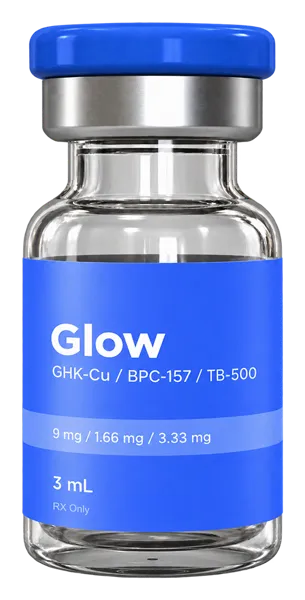
| Glow-style blends (GHK-Cu + BPC-157 + TB-500) | Skin plus recovery (as marketed) | No human study of the combination; each component’s evidence is mostly preclinical | All of the above, times three ingredients |
For a fuller head-to-head on the topical side, see copper peptides vs retinol.
What is in the glow blend, and why stack GHK-Cu?
“Glow” blends pair GHK-Cu with BPC-157 and TB-500, two peptides promoted for tissue recovery, on the theory that skin repair and tissue repair signals add up. That theory has not been tested in people. BPC-157’s evidence is mostly preclinical, and TB-500’s human data come from studies of its full-length parent protein for eye and heart conditions, not the fragment sold in vials (see our TB-500 overview). We found no published human study of GHK-Cu combined with either one. The blend is a social-media construct built from three individually under-studied pieces.
What does GHK-Cu cost?
Topical copper-peptide serums are sold as cosmetics, and we have not surveyed their prices. For the injectable side, one dated reference point: Bodybuilding Peptides listed its Glow Blend (GHK-Cu with BPC-157 and TB-500, injectable) at $353 for a one-month plan when we checked on October 12, 2026; it does not sell GHK-Cu on its own. Prices change, so treat that as a snapshot. Our peptide therapy cost explainer covers how monthly plans compare across substances.
What are people saying about GHK-Cu?
Online, GHK-Cu shows up less as a standalone topic and more as a line item in bigger stacks. Our community tracker does not yet have a dedicated GHK-Cu dataset, but it surfaces in the X posts we collected for other peptides in July 2026:
- As part of a routine. In 19 MOTS-c posts collected July 16 to 19, 2026, users listed GHK-Cu among the things they combine with MOTS-c, alongside NAD+, GLP peptides and pre-workout, often around fasting and cardio.
- Mixing questions. In 13 thymosin alpha-1 posts from July 9 to 16, 2026, one user said she mixes TA1 with GHK-Cu and that it eliminated her histamine response to GHK-Cu, while another named TA1 among peptides they consider incompatible for co-mixing. These are individual reports with no way to verify them.
- Recovery stacks. In 8 KPV posts from July 18 to 20, 2026, users described stacking KPV with BPC-157, TB-500 and GHK in injury and daily routines.
Beyond our data, the wider conversation has a clear split. NPR’s reporting captures the enthusiasts (the looksmaxxing and glow crowd), the cautious researchers (a longtime GHK researcher told NPR he would not inject it himself without knowing what it will do), and a clinician who says most of his GHK-Cu consults are with people who have already bought it online and self-injected. The fact-check that matters: the skincare studies behind the cosmetic claims were done on creams applied to skin, so they say nothing about what a gray-market injectable will do.
These are a small number of self-reports and press accounts, not evidence that GHK-Cu works or is safe by any route.
The bottom line on GHK-Cu
GHK-Cu is a genuinely interesting molecule with a believable skin-repair story, a long cosmetic track record, and a human evidence base that is smaller and softer than its fans suggest. Topically, the evidence supports modest expectations at best, and better-studied options such as prescription tretinoin exist. Injected, it is an experiment on yourself with no published human data, real questions about immune reactions and copper load, and no assurance about what is in the vial. If your goal is better skin or hair, a dermatologist can weigh the options that have stronger evidence first.
Status: Not FDA-approved; sold by some telehealth providers as a compounded prescription. This applies to injectable GHK-Cu; topical GHK-Cu is sold as a cosmetic ingredient. What this status means.
Sources: Pickart et al., BioMed Research International, 2015; Pickart and Margolina, International Journal of Molecular Sciences, 2018; Najafi et al., Archives of Internal Medicine Research, 2026; Mortazavi et al., BioImpacts, 2025; Mulder et al., Wound Repair and Regeneration, 1994; Bishop et al., Journal of Vascular Surgery, 1992; Pyo et al., Archives of Pharmacal Research, 2007; FDA, bulk drug substances that may present significant safety risks; NIH Office of Dietary Supplements, copper fact sheet; DailyMed, Renova (tretinoin cream) 0.02% label; NPR, September 7, 2026.
Educational information only, not medical advice. Updated October 12, 2026.
Sources (11)
Advertising disclosure: links marked "Paid link" go to Bodybuilding Peptides (trybbpeptides.com), an affiliate destination, and The Treatment Report may earn a commission if you buy there. Our coverage is independent of that relationship, and nothing on this page is medical or legal advice.
 See it at Bodybuilding Peptides